

Since the Jets returned to Winnipeg in 2011, fans have had to jump through hoops when discussing the NHL records of the 2.0 era.
The league recognizes the current Jets as the continuation of the franchise that previously played in Atlanta, meaning all Atlanta Thrashers records from 1999 to 2010 are included in the Jets 2.0 history.
Of course, when fans in this city think of the franchise’s all-time goal leader, they picture Dale Hawerchuk (379) in first place, being chased by Mark Scheifele (350), with Kyle Connor (299) in third. But by NHL standards, the guy in third is Ilya Kovalchuk (328)—a player who never wore a Jets jersey or played a single game in Winnipeg.
There is literally a statue of the man known forever as Ducky standing outside the arena, yet by the NHL rulebook he has “no connection” to the current franchise. Try telling that to a single Manitoban.
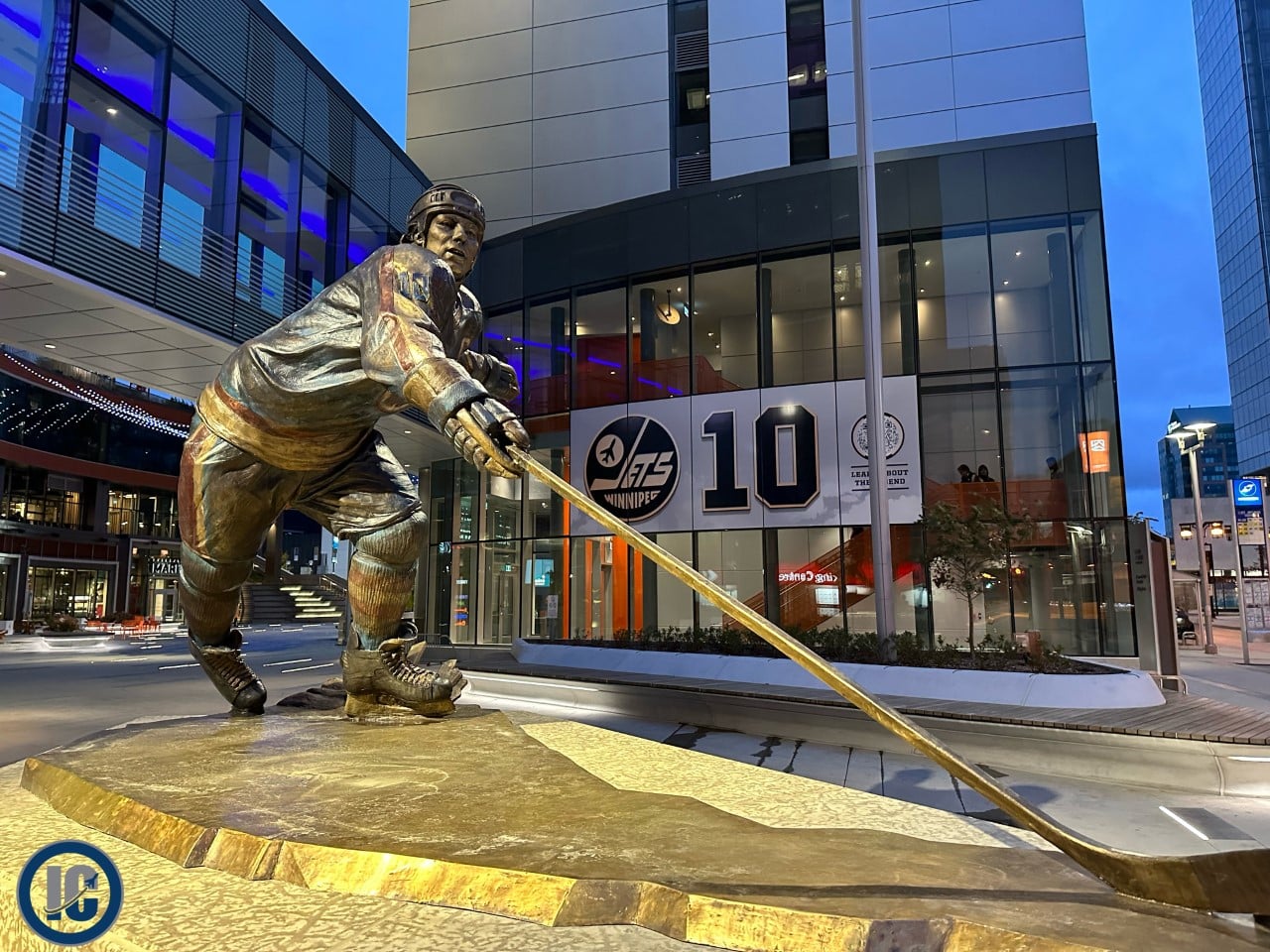
Photo Credit: Dave Minuk (Illegal Curve)
Before the Coyotes moved to Utah and eventually became the Mammoth, the history of the Jets 1.0 era resided with the old Arizona franchise. But when they moved in April 2024, the NHL declared the Utah Mammoth a new franchise, leaving the original Jets and Coyotes records behind.
That means Teemu Selanne’s iconic 76-goal, 132-point rookie season—and so many other classic memories from the 1980s and 90s—were back on the table for Winnipeg.
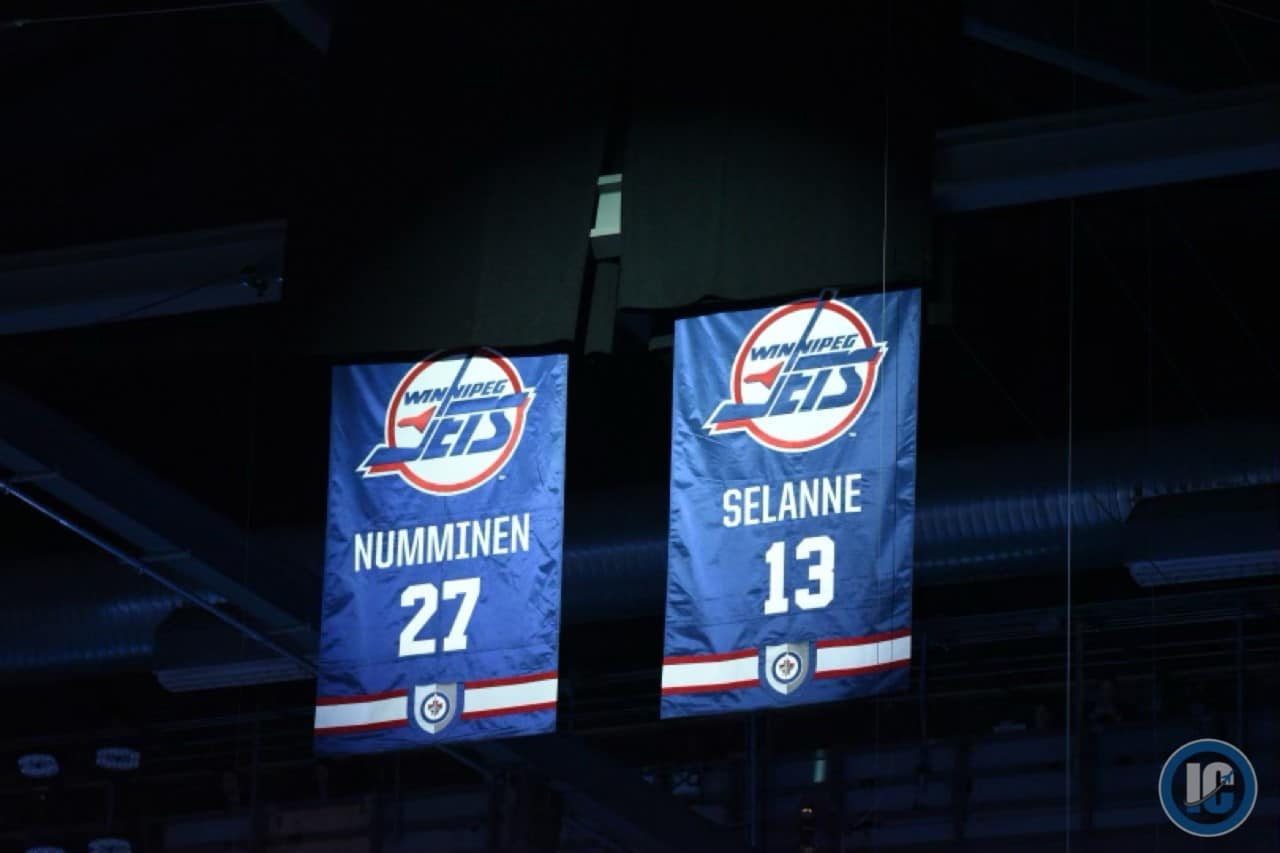
Photo Credit: Alexander James (Illegal Curve)
Looking at this pragmatically, regardless of what is official, the team already does “unofficially” connect themselves to the previous franchise. The alumni from the 1.0 era are part of the 2.0 team, with former Jet/Manitoban Ray Neufeld heading up the alumni association.
When Winnipeg hosted the Heritage Classic in 2016, they played two games: one being the game between the Edmonton Oilers and Winnipeg Jets that counted towards the season’s standings, and the other an alumni game featuring players from the 1.0 Jets. You didn’t see Thrashers greats like Kovalchuk, Slava Kozlov, Marian Hossa or Marc Savard on the ice.
On December 17th, 2011, when the Ducks visited Winnipeg, why did fans go bananas over the return of the Finnish Flash for the first time since the franchise left? They gave him a pre-game ovation, the team had a Tribute Video and then a massive cheer when he was named 1st Star.
In practice, the current Jets function as a de facto successor to the original franchise: not a legal continuation under NHL rules, but a continuation in spirit, culture, fan identity, and alumni engagement.
Officially, the rulebook draws a line; in practice, the people of Winnipeg see continuity.
When NHL Commissioner Gary Bettman was asked by Murat Ates of The Athletic Winnipeg about merging Jets 1.0 and Jets 2.0 records during his visit to the city this week, he said this:
“Mr. Chipman has raised that issue with us repeatedly. It’s not as simple as just doing it. One of the projects of recently retired Gary Mahar, who ran communications prior to Jon Weinstein, now who’s looking at is to see the feasibility of how that would actually work. It’s just not simply throwing it up, so it is something we’re looking into.”
Murat followed up by asking whether the complication was due to figuring out the process of consolidating the records.
Bettman responded:
“It’s not so much a process. It’s what the end result would look like and can we make it make sense? The process is trying to figure it out, which is what we’re trying to do.”
Deputy Commissioner Bill Daly added:
“I don’t know if you’ve looked at it with respect to other teams in other leagues. They’re kind of all over the map in terms of how they’ve done it. Some have worked more well than others, so it’s tricky.”
I understand why the NHL says it isn’t simple. For the vast majority of teams, the records moved with the relocated clubs. We saw this with the Colorado Rockies in New Jersey, Quebec Nordiques in Colorado, Minnesota North Stars in Dallas, Atlanta Flames in Calgary, etc.
The NHL’s decision to divest Utah of the Coyotes/Jets 1.0 history could finally give Winnipeg a chance to reclaim the records and memories that have long belonged to the city in spirit, not in the record book. The Thrashers’ stats currently attached to the 2.0 Jets could be separated, allowing the franchise’s official history to align more closely with the way fans have always understood it.
Officially, the records may say one thing, but in practice, Winnipeg has long treated the Jets as a single, continuous story—from Hawerchuk to Scheifele, from Selanne’s 76-goal rookie season to today’s stars. The team has long embodied the spirit and continuity of the original franchise through its culture, alumni engagement, and fan identity. Now, the league may have the opportunity to let the statistics finally catch up with the sentiment, reuniting the city with the full history of the team it has always called its own.


